Guide
Chamberlain, Clopay and Wayne Dalton: What Actually Fails on Each
Published October 5, 2026
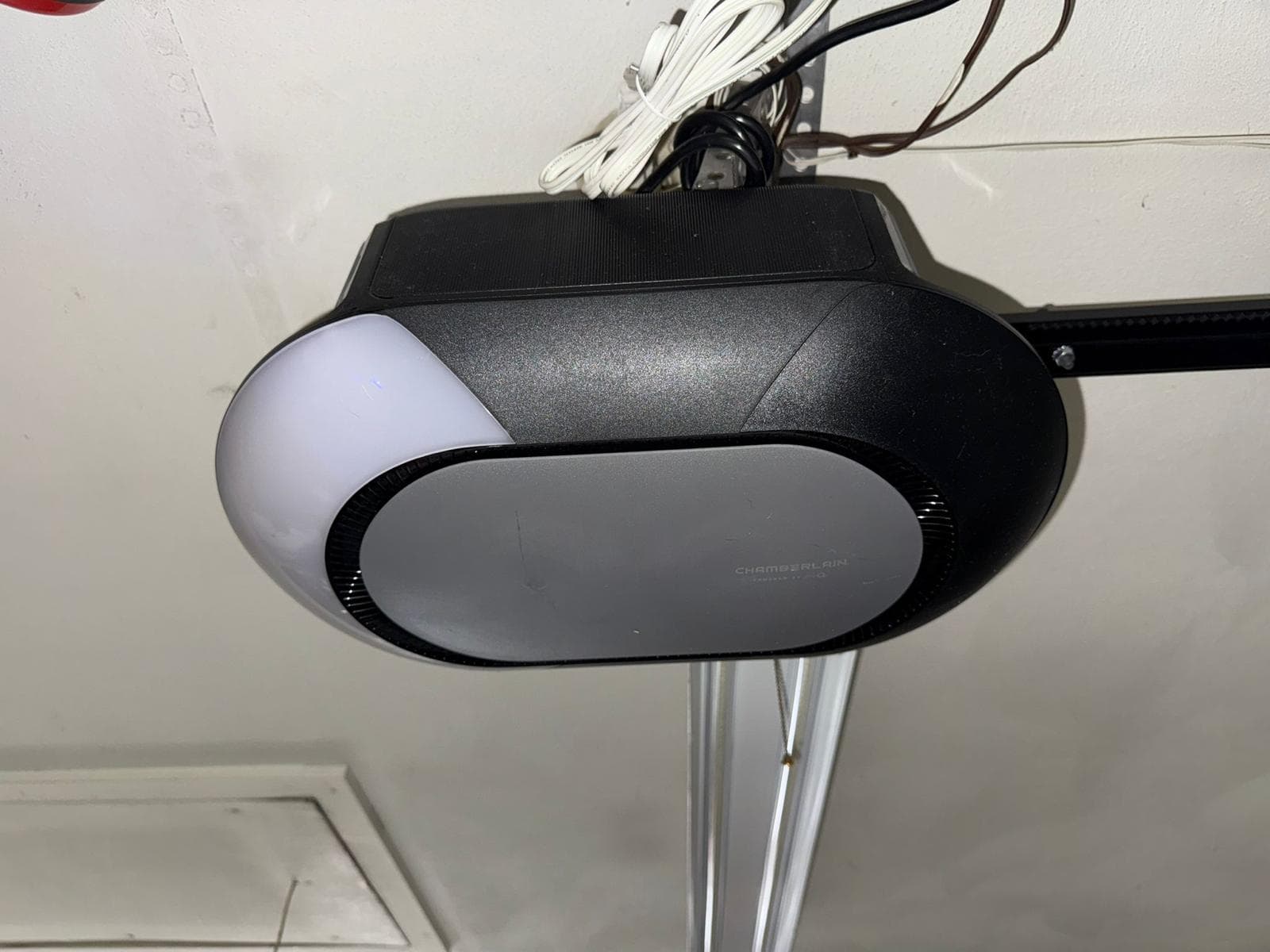
There are two badges on a garage door system and they tell you different things. The one on the motor head overhead is the opener brand — usually Chamberlain or LiftMaster around here — and it predicts electrical and gear faults. The one on the door itself is the door brand — usually Clopay or Wayne Dalton — and it predicts panel, spring and corrosion faults. Knowing both narrows the diagnosis before anyone looks at the door, and in most cases points at a repair rather than a replacement.
Chamberlain and LiftMaster: the same machine in two colours
Chamberlain and LiftMaster share a parts platform. That is the single most useful fact about them, because it means gear kits, logic boards, trolleys, sensors and remotes are widely available for both — and a fifteen-year-old unit of either make is usually still economically repairable.
Three faults account for most Chamberlain calls. The door reverses on closing while the opener light flashes, which is photo-eye sensors misaligned, obstructed, dirty, or carrying a broken wire at the terminal. The motor runs but the door does not move, which is almost always a stripped plastic drive gear inside the motor head — a repair kit, not a new opener. And the remote works up close but not from the driveway, which is a weak battery, a damaged antenna wire hanging from the motor head, or radio interference from an LED bulb fitted inside the opener itself.
Two more worth knowing. A door that stops partway or reverses at the floor is usually travel and force limits that have drifted, or a door that has become genuinely hard to move so the opener reads it as an obstruction. And myQ or Wi-Fi dropping out is a signal problem: the motor head sits in a metal-framed space at the far end of most houses from the router.
Clopay: the door where one panel is often enough
Clopay is one of the most widely installed door brands in this area and one of the more practical to repair. Sections for current models are generally available, which means a single dented panel often does not require a whole new door — though whether a section can be matched depends on that model and panel design still being in production.
The faults follow the construction. A dented or creased section is almost always vehicle impact, and is frequently a single-section replacement. A bottom section rusting through is winter road salt sitting against the lowest few inches of steel, and it stops being cosmetic the moment it perforates, because that section carries the cable brackets.
One Clopay-specific trap: the range runs from single-layer steel through to insulated three-layer and wood-composite carriage house doors, and the insulated models are noticeably heavier. Fitting an insulated Clopay in place of an uninsulated door without re-sizing the springs to the new weight produces a door the opener cannot manage — and an opener that burns out early trying.
Wayne Dalton: the broken spring you cannot see
Wayne Dalton deserves its own section for one reason. Many of their doors use the TorqueMaster spring system, where the springs sit enclosed inside the tube above the door rather than exposed on a shaft.
That changes diagnosis completely. The standard way to check for a broken spring is to look for a gap in the coil — and on a TorqueMaster you cannot see the coil at all. The symptom instead is a door that has suddenly become very heavy, or will not lift, with nothing visibly wrong anywhere. A door lifting unevenly on one side usually means one of the two enclosed springs has failed while the other is still intact.
The system is safer in one respect, because a spring that breaks stays contained inside the tube. But replacement follows a different procedure from a conventional torsion setup, and the parts are specific to the system — including when a cable slips inside the tube, which needs the TorqueMaster procedure rather than conventional drum rewinding. It is worth knowing which system you have before you call anyone.
What the badge does not tell you
Brand predicts the likely fault. It does not predict the age of the system, and age is what actually decides whether something is repaired or replaced.
The clearest example is the opener. Most opener problems are genuinely repairable regardless of make — gears, boards, trolleys, sensors, remotes and belts are all available parts. The cases where replacement is the honest answer are a burned-out motor, a discontinued board on a very old unit, and an opener old enough to have no photo-eye sensors at the base of the tracks, which puts it before January 1993 and outside the federal entrapment-protection requirement.
The other thing the badge does not change is the weather. Bottom-section rust from winter road salt turns up on steel doors of every make in this region, Clopay and Wayne Dalton alike. The brand changes which part fails first; the Cincinnati winter decides when.
Warning signs before a full break
- Opener light flashing while the door refuses to close
- Motor running with the door not moving — a stripped drive gear
- Remote working at the door but not from the driveway
- A door that has suddenly become very heavy with no visible broken spring
- The door lifting noticeably faster on one side than the other
- Rust along the lowest few inches of a steel door section
- A new insulated door that the existing opener now struggles with
Frequently asked
Is Chamberlain or LiftMaster better?
They share a parts platform, so for repair purposes the distinction barely matters — the same gear kits, boards, sensors and remotes fit both. Choose on the drive type and features rather than the badge: belt drives run noticeably quieter than chain, which matters when there is a bedroom above the garage.
How do I know if my Wayne Dalton has TorqueMaster?
Look above the door opening. A conventional system has visible springs wound around an exposed steel shaft. TorqueMaster has a smooth enclosed tube with nothing visible inside it. If you cannot see springs, that is the system you have, and a broken one will not look broken.
Can one dented panel be replaced, or do I need a whole door?
On a Clopay it is often a single section, provided that model and panel design are still in production. That is genuinely brand-dependent and model-dependent, so it is one of the questions that gets answered by looking at the door rather than over the phone.
My opener is fifteen years old. Is it worth repairing?
Usually yes, if it is a Chamberlain or LiftMaster — parts availability is good and fifteen years is not old for these units. The question that actually decides it is whether it has photo-eye sensors at the base of the tracks. If it does not, it predates the 1993 safety requirement and replacement is the honest recommendation regardless of make.
Do you work on brands other than these?
Yes — Genie and Amarr among others, and plenty of doors with no legible badge left on them at all. The brand narrows the likely fault, but the inspection covers the same twenty-one points either way.
Related service
If this is happening to your door right now
Get the free inspection before it becomes an emergency
The 21-point inspection checks spring condition and remaining life along with the hardware around it, and you get the written findings — no charge, no obligation. We're open 24 hours across Greater Cincinnati and Northern Kentucky.
Written by the PowerLift Garage Door team, based on repairs made across Greater Cincinnati and Northern Kentucky. About us