Guide
Garage Door Broken? What Is Actually Wrong, and What to Do Right Now
Published October 12, 2026
"Broken" nearly always means one of six things: a snapped spring, a snapped or slipped cable, a door that has jumped its track, an opener that runs but does not move the door, photo-eye sensors that stop it closing, or worn rollers making it grind. What you heard and what you see narrows it to one or two of those before anyone touches the door. The one rule that matters right now: stop pressing the button. An opener pushing against a door that cannot move is how a small repair becomes a large one.
Start with what you heard and what you can see
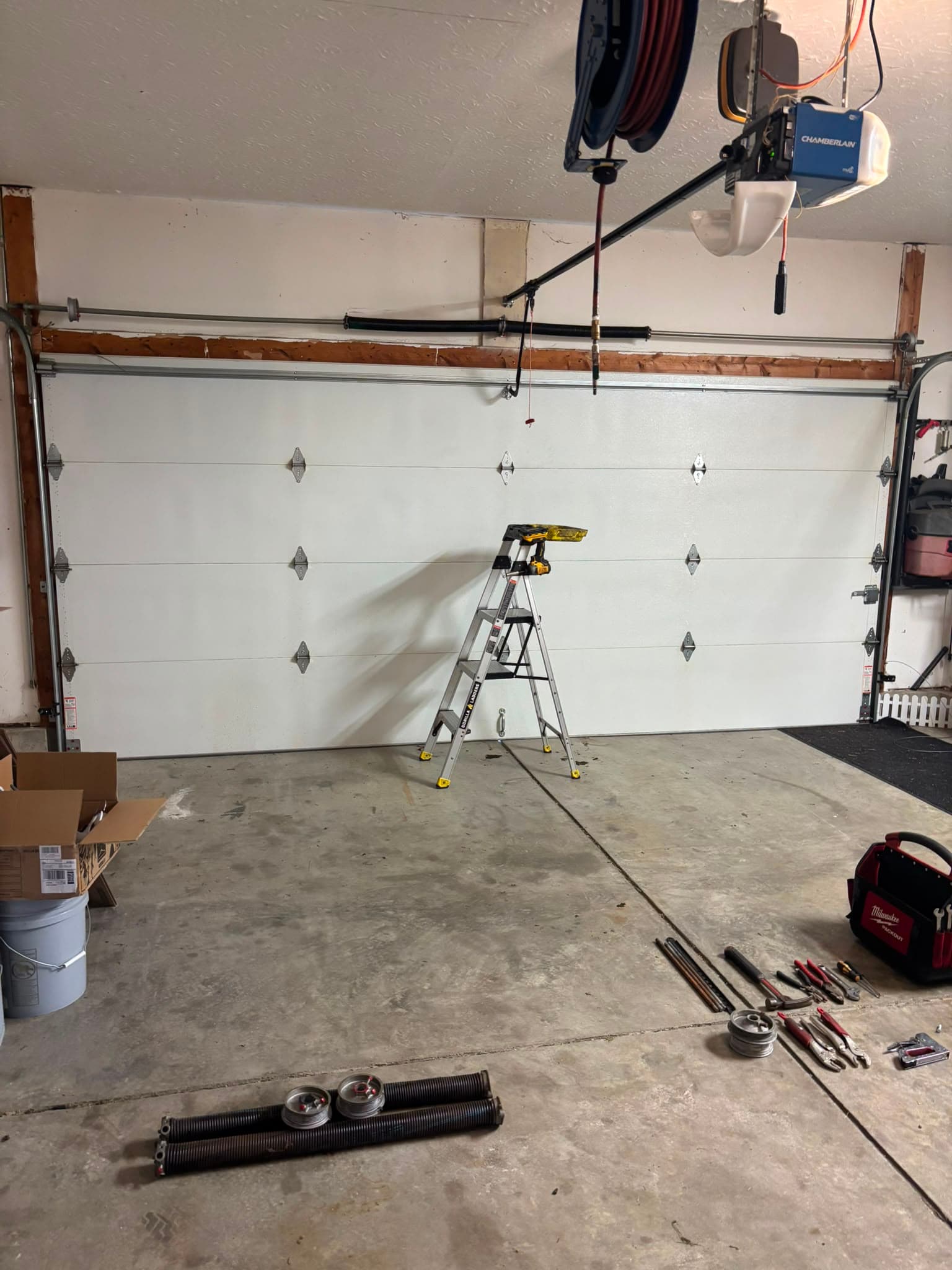
A loud bang from the garage, often mistaken for a gunshot or something falling, followed by a door that will not open or lifts a few inches and stops: that is a broken spring. Look above the door. On a conventional system you will see a two-inch gap in the coiled spring. If you cannot see any spring at all, you have an enclosed system and the broken one will not look broken; the door simply feels extremely heavy by hand.
One side of the door hanging lower than the other, a door crooked in the opening or wedged in the track, a loose cable dangling beside it, or a frayed cable with broken strands like a rope coming apart: that is a cable. Rust streaks running down from the bottom bracket often show up first, because road salt eats the bottom of the door before anything else.
The door visibly out of the metal track on one side, jammed at an angle, with a roller lying on the floor or a visible kink in the vertical track: the door is off-track. This usually follows one of three things: a vehicle tapped it, a cable let go, or a worn roller finally came out of the channel.
The opener hums or runs but the door does not move, or there is a grinding noise from the motor unit with no movement: that is inside the opener, most often a stripped drive gear. The door closing partway, reversing, and the opener light flashing: that is the photo-eye sensors at the bottom of the tracks, misaligned, dirty or with a broken wire. The remote working close up but not from the driveway is a battery, an antenna wire or interference, not a broken door at all.
A door that has become much louder than it used to be, grinding, squealing or rattling as it travels, with black dust or metal shavings below the track: rollers. A door that reverses right at the floor and immediately opens again: usually opener travel and force limits that have drifted, or a door that has become genuinely hard to move, so the opener reads it as an obstruction.
What to do right now, before anyone arrives
Stop using the opener. Every one of the failures above gets worse when a motor keeps pushing against it: a stripped gear strips further, a door half off its track bends the track, and an opener trying to lift a door with a broken spring is lifting a weight it was never designed to carry.
Do not pull the red release cord if the door is open, or if you suspect a spring has broken. The release disconnects the door from the opener, and with a broken spring there is nothing left holding the door's weight. It can come down fast. If the door is already closed and the spring is broken, leave it closed.
Do not touch the springs, the cables, or the bottom brackets the cables attach to. They hold the full tension of the spring system even when the door looks dead. This is the one part of garage door repair we tell homeowners never to attempt, because a winding bar that slips releases that energy in a fraction of a second.
If the door is stuck open and the house cannot be secured, or stuck closed with a vehicle inside, that is an emergency call at any hour, not a next-available appointment. If it is stuck closed and the car is outside, keep people and pets away from the door and it can wait until morning.
What is a repair and what is not
Almost everything above is a repair, usually in one visit. Springs are replaced and re-sized to the door's weight. Cables are replaced in pairs. An off-track door is put back on the track, with the roller or hinge that caused it replaced and the track straightened. Opener gears, logic boards, sensors, trolleys and remotes are all available parts for the brands common around Cincinnati.
Three things honestly point at replacement rather than repair. An opener with no photo-eye sensors at the base of the tracks predates the federal entrapment-protection requirement that took effect on January 1, 1993, and should not be repaired. A bottom section that has rusted through, or several dented or creased sections, usually costs more to patch than a new door. And a very old opener whose board is discontinued is a replacement whatever the brand.
Everything else, including a door that has been "broken" for months and simply hauled up by hand, is normally fixable, and the fix usually costs less than people expect once they stop assuming the whole door is finished.
What happens when we come out
The visit starts with the free 21-point safety inspection, whatever you called about. The part that failed is rarely the only part that is worn: a snapped cable usually has a corroded bottom bracket behind it, a broken spring has often been carried by the opener for weeks, and a door that jumped its track usually did so because a roller had been failing for a while.
You get the written findings, including what we checked and found sound, and a price before anything is touched. If the answer is that nothing needs doing beyond the part that failed, that is what the report says.
Warning signs before a full break
- A loud bang followed by a door that will not lift: broken spring
- One side lower than the other, or a dangling cable: snapped or slipped cable
- Door jammed at an angle, out of the metal track: off-track
- Opener hums or runs but the door does not move: stripped drive gear
- Door closes partway, reverses, opener light flashes: photo-eye sensors
- Grinding and black dust below the track: worn rollers
- No photo-eye sensors at the bottom of the tracks at all: pre-1993 opener, replace rather than repair
Frequently asked
My garage door is broken and my car is inside. What do I do?
Call rather than try to force it. If the spring is broken the door is far heavier than it looks, and lifting it by hand with the opener disconnected is how people get hurt. A car trapped inside is treated as an emergency at any hour.
Can I pull the red cord and open it by hand?
Only if the springs are intact and the door is closed. With a broken spring, the release cord removes the one thing still holding the door up, and an open door can come down fast. If you heard a bang, or the door feels extremely heavy, leave the cord alone.
The door will not close and the opener light is flashing. Is that broken?
Usually not. A flashing light with a door that reverses on the way down is the photo-eye sensors at the bottom of the tracks: knocked out of line, dirty, blocked by something on the floor, or with a broken wire at the terminal. It is one of the quickest fixes there is.
How do I know whether it is the spring or the opener?
Look above the door for a gap in the coiled spring. If there is one, it is the spring. If the spring looks whole and the opener hums or grinds without moving the door, it is the opener. If you cannot see any spring at all, you have an enclosed spring system, and a door that has suddenly become very heavy is the sign.
Does a broken garage door mean I need a new one?
Rarely. Springs, cables, rollers, tracks, sections and opener parts are all repairable or replaceable individually. Replacement is the honest answer for a rusted-through bottom section, several damaged sections, or an opener old enough to have no safety sensors, which puts it before 1993.
Related service
If this is happening to your door right now
Get the free inspection before it becomes an emergency
The 21-point inspection checks spring condition and remaining life along with the hardware around it, and you get the written findings — no charge, no obligation. We're open 24 hours across Greater Cincinnati and Northern Kentucky.
Written by the PowerLift Garage Door team, based on repairs made across Greater Cincinnati and Northern Kentucky. About us